



On 15 January 2026, an expert lecture introducing the SpectroLight610 instrument, acquired within the APBC consortium, was held at the Institute of Neuroimmunology of the Slovak Academy of Sciences (SAS) in Bratislava. The event provided researchers and students with an overview of modern approaches to protein analysis and highlighted new opportunities for collaboration in the field of structural biology.
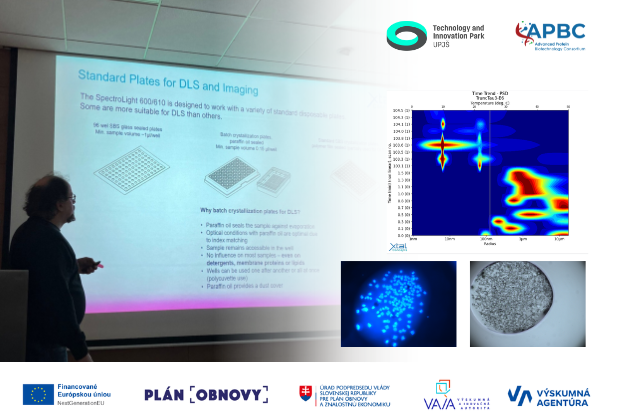
The lecture was delivered by Dr. Arne Meyer from Xtal Concepts (Hamburg, Germany), who presented the technological capabilities of the instrument and its potential applications, particularly in studies of protein conformation, stability, and protein crystallization experiments. The SpectroLight610 enables measurements of dynamic light scattering in nanoliter sample volumes, representing an important advantage when working with limited amounts of biological material. In addition, the instrument provides high-resolution imaging of samples in the visible spectrum, including fluorescence detection, allowing researchers to monitor the behaviour and quality of protein samples under different conditions. These capabilities make the instrument particularly valuable for experiments aimed at protein crystallization, a key step in determining the three-dimensional structure of proteins. The possibility to rapidly detect sample aggregation, assess sample homogeneity, and identify optimal crystallization conditions can significantly increase the success rate of experiments while saving time and research resources.
The lecture was followed by an engaging discussion with students and researchers from the Institute of Neuroimmunology SAS, the Institute of Chemistry SAS, and the Institute of Molecular Biology SAS. The discussion focused on the practical implementation of the instrument in ongoing research projects and on addressing specific challenges related to protein crystallization and protein stability. In addition to senior scientists, the event was attended mainly by PhD students and early-career postdoctoral researchers, for whom hands-on experience with modern analytical technologies represents an important part of their scientific training.
Collaboration with Dr. Meyer will continue, particularly in the development and optimization of experimental protocols for testing protein stability under various environmental conditions using the SpectroLight610 instrument. The introduction of this technology represents an important step toward the modernization of experimental infrastructure and supports the advancement of high-quality research in molecular and structural biology.