



On April 9, 2026, early-career researchers, PhD students, and master’s and bachelor’s degree students (10 participants in total) attended a professional seminar focused on the multi-angle dynamic light scattering (MADS) method for protein analysis. The seminar introduced the principles of the method, its applications in biomolecular research, and provided practical training on the newly acquired laboratory instrumentation purchased within the APBC project.
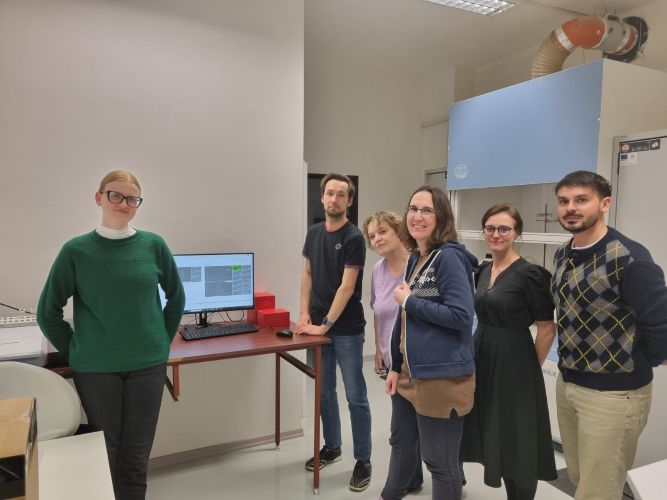
The new DLS (Dynamic Light Scattering) instrument equipped with a multi-angle module represents a significant expansion of the laboratory’s analytical capabilities. It enables the determination of particle size based on the analysis of fluctuations in the intensity of scattered light caused by Brownian motion, while measurements are performed simultaneously at three scattering angles. This considerably improves the sensitivity, accuracy, and resolution of the method, which is particularly important for the analysis of complex biological systems.
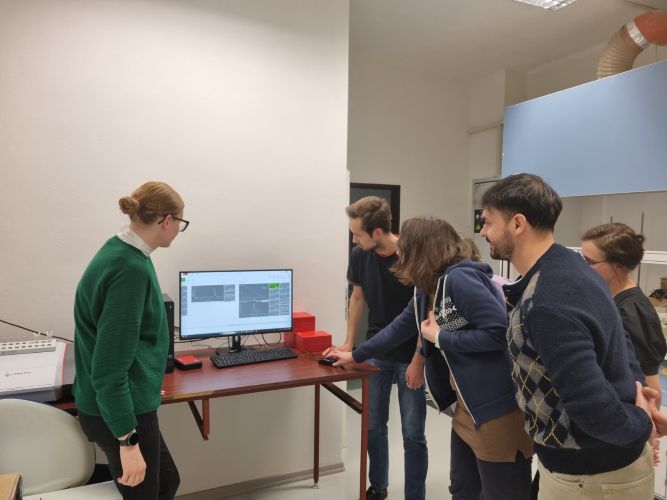
The implementation of this technology will open new opportunities for the characterization of protein aggregates, nanoparticles, and eutectic mixtures. In addition to particle size determination, the instrument will allow detailed analysis of zeta potential and particle stability under various conditions. The new instrumentation will therefore not only broaden the scope of experimental activities at the workplace, but also support the development of interdisciplinary and international scientific collaboration.