



Artificial intelligence has attracted increasing attention in recent years not only in technology and business but also in legal practice. A significant example of the integration of law and modern technologies is the research project APVV-21-0336 “Analysis of Judicial Decisions Using Artificial Intelligence Methods”, carried out in collaboration between experts from the Faculty of Law and the Faculty of Science at Pavol Jozef Šafárik University.
Artificial Intelligence in Judicial Decision Analysis
The applied research project APVV-21-0336 focused on the use of artificial intelligence methods for the processing and analysis of judicial decisions. Its objective was to develop tools capable of working more efficiently with extensive databases of legal documents, identifying relationships among judicial decisions, and supporting legal professionals, judges, and researchers in locating relevant legal information. The end user of the project outcomes is the Office of the Supreme Court of the Slovak Republic.
In a legal environment where thousands of new judicial decisions are issued each year, artificial intelligence technologies provide significant support in navigating case law. Modern algorithms can analyse legal texts, identify similar cases, extract legal arguments, and provide valuable assistance for legal research and analysis.
Collaboration Between Legal Scholars and Computer Scientists
One of the project’s most significant achievements was the interdisciplinary cooperation between experts in law and computer science. The research team included scholars from the Faculty of Law (Gabriela Dobrovičová, Regina Hučková, Laura Bachňáková, Simona Rudohradská, Diana Treščáková, and others) and the Faculty of Science (Pavol Sokol, Peter Gurský, Dávid Varga, Zoltán Szoplák, and others), who combined their expertise to develop practical solutions applicable within the judiciary.
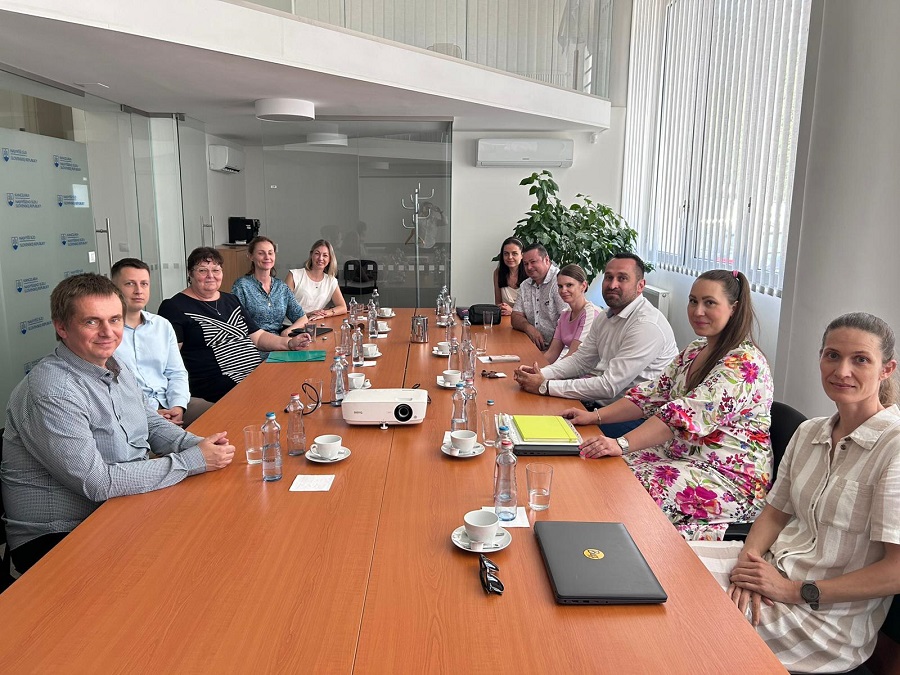
Such interdisciplinary collaboration has become essential, as the development of AI-based legal tools requires not only technological expertise but also a thorough understanding of legal processes, legal terminology, and the specific characteristics of judicial decision-making.
Consultation with the Supreme Court of the Slovak Republic
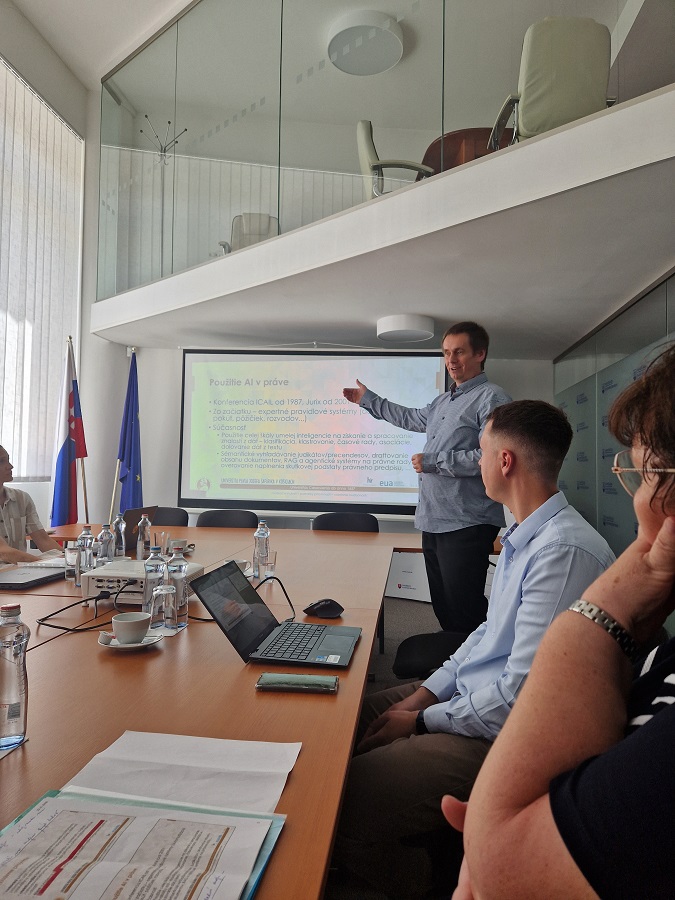
The final meeting with representatives of the Supreme Court of the Slovak Republic focused on presenting the project’s outcomes and discussing their practical application. Participants explored opportunities to implement the developed AI tools in judicial decision-making processes and considered further avenues for cooperation between the university and judicial institutions.
TPartnerships of this kind make an important contribution to the modernisation of the judiciary by transferring scientific research directly into legal practice and addressing the evolving needs of judicial institutions.
Benefits for Legal Practice
The application of artificial intelligence in the legal domain offers several significant advantages, including:
- faster processing of large volumes of legal documents;
- more efficient retrieval of relevant case law;
- support for greater consistency in judicial decision-making;
- improved accessibility of legal information;
- enhanced opportunities for legal research.
It is important to emphasise that artificial intelligence is neither intended nor able to replace judges in their decision-making role. Rather, its purpose is to provide analytical support and improve the efficiency of working with legal information.
Future Perspectives
The results of project APVV-21-0336 demonstrate that integrating legal science and artificial intelligence is a promising direction for future research. As the volume of legal data continues to grow, the importance of intelligent analytical tools will likewise continue to increase.
The cooperation between Pavol Jozef Šafárik University and the Supreme Court of the Slovak Republic also demonstrates that Slovak academic institutions are capable of developing innovative solutions with practical applications in the judiciary. In the future, research of this kind may contribute to more efficient court operations, improved access to legal information, and the overall modernisation of the Slovak legal system.