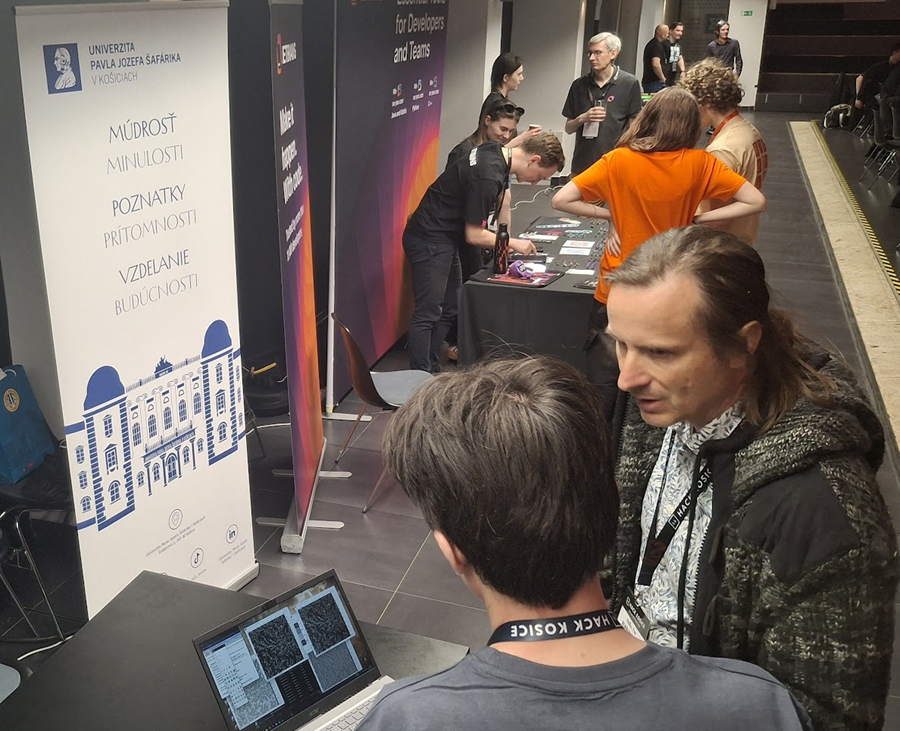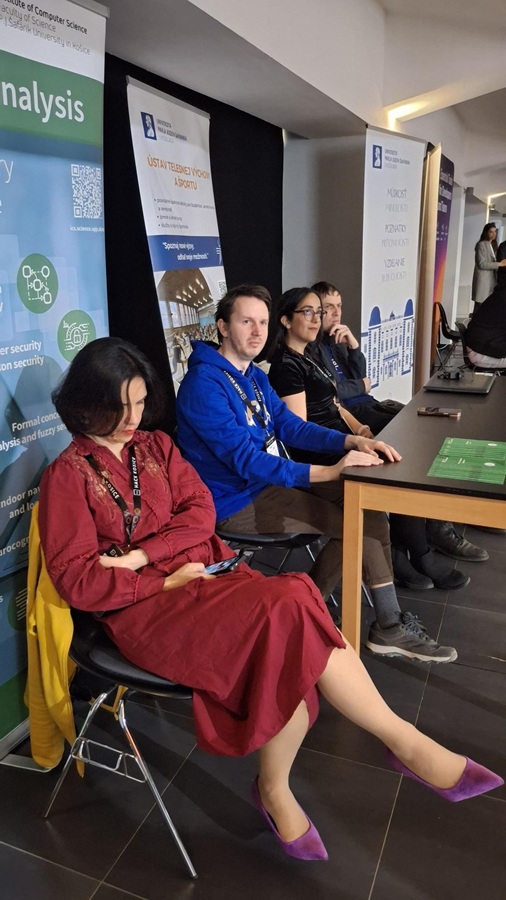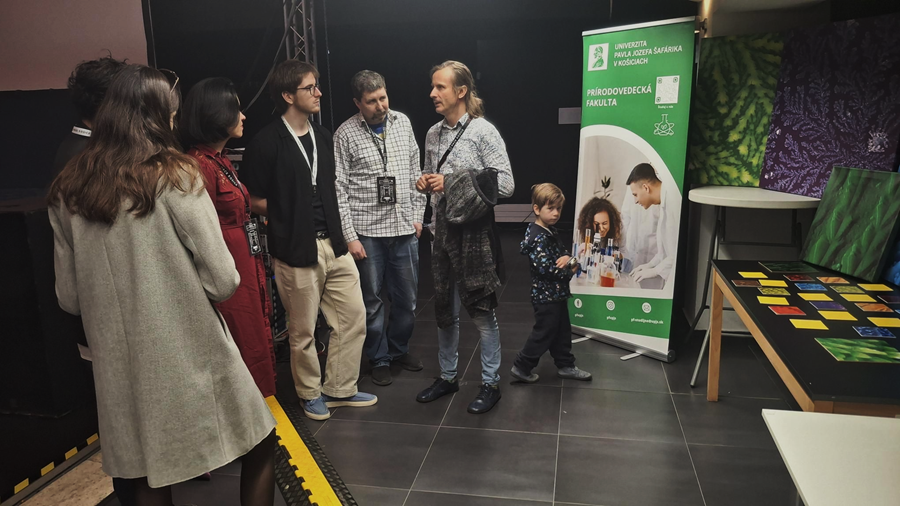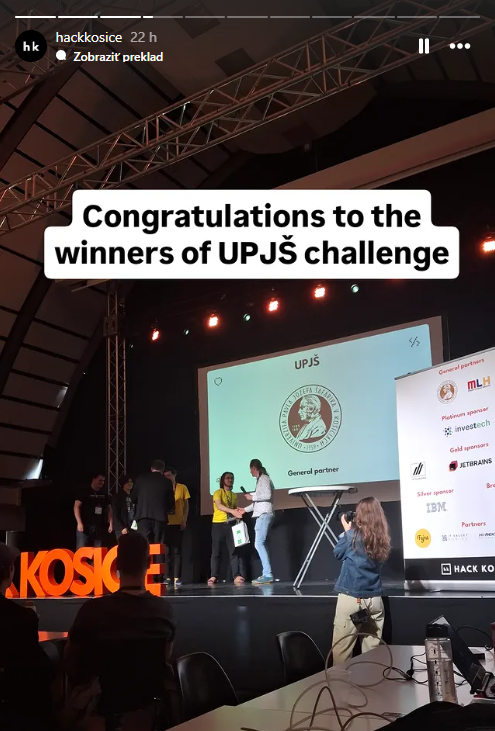



Pavol Jozef Šafárik University in Košice, via its Faculty of Science, acted once again as the general partner of the international hackathon Hack Košice 2026, held under the auspices of Major League Hacking. This year marked the seventh edition of the event.

The hackathon confirmed its strong international character, bringing together 180 participants from 16 countries. During an intensive weekend on April 18–19, 2026 teams worked on innovative solutions in the fields of technology, data analysis, and artificial intelligence at the Kunsthalle in Košice.
The Faculty’s participation in the event reflects its long-term focus—bridging various scientific fields and addressing real-world problems. At UPJŠ, expertise from data science, artificial intelligence, natural sciences, and biomedicine comes together, creating a strong foundation for impactful innovation.
Hackathons provide an ideal environment where these principles are translated into practice — rapidly, creatively, and through teamwork across disciplines.
A research team from UPJŠ prepared a technical challenge for participants focused on analyzing mathematical and image data of tear fluid obtained via atomic force microscopy using machine learning methods.
The goal was to design a classification model capable of distinguishing healthy individuals from patients with selected ocular and systemic diseases. Thirteen teams competed, applying machine learning methods to five datasets of tear fluid results from healthy subjects, patients with dry eye syndrome, glaucoma, diabetes mellitus, and multiple sclerosis, to determine the specific disease based on the analysis of the surface and arrangement of crystalline structures formed in a single tear drop. This experimental approach represents a promising direction in the development of non-invasive, sensitive, and innovative diagnostic methods that could be applied in clinical practice.
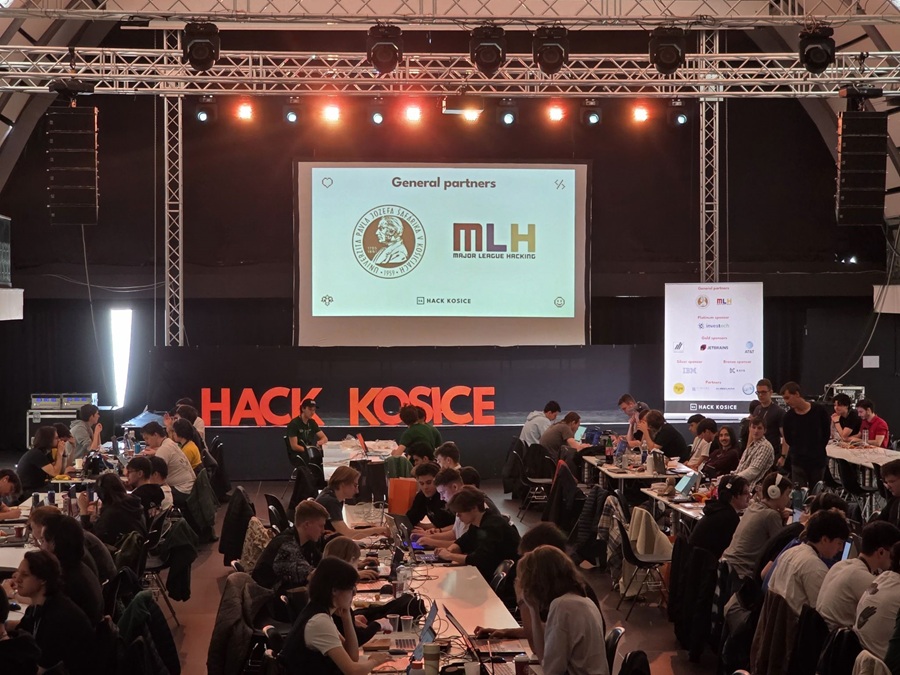
The organization of the event and the Faculty’s involvement were the result of a broader collaboration involving colleagues from the Centre of Applied Computer Science and Institute of Computer Science and the Faculty of Medicine, UPJŠ. The event was also supported by the Institute of Physical Education and Sport, UPJŠ, which loaned equipment for the physical recovery of the hackers.
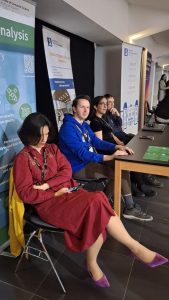
The challenge was prepared by Assoc. Prof. Vladimír Komanický (Institute of Physics, Faculty of Science, UPJŠ), Assoc. Prof. Ľubomír Antoni (Institute of Computer Science, Faculty of Science, UPJŠ), Prof. Vladimíra Tomečková (Department of Medical and Clinical Biochemistry, Faculty of Medicine, UPJŠ), and Dr. Daria Kondrakhova (Institute of Materials Research, Slovak Academy of Sciences).
Special thanks go to mentors Ľubomír Antoni and Richard Staňa, as well as to the team members who significantly contributed to the smooth running of the event: Juraj Šebej, Ľudovít Hvizdoš, Eduard Dvorný, Stanislav Varga, Miron Kuzma, Tomáš Tkáčik, Matúš Klimko, Eva Marková, Roman Varga, Mikuláš Marko, Gabriel Semanišin, Michal Gallay and Roman Soták.
An important role was also played by our students Hugo Halász and Jakub Žoldák, who acted as a bridge between the core organizing team and the Faculty.
Participation of the Faculty of Science in Hack Košice underscores its active role in supporting young talent, innovation, and the integration of the academic community with the professional world. Events like hackathons clearly demonstrate that the solutions of the future emerge at the intersection of disciplines — where data, technology, real societal challenges, and motivated young people meet.