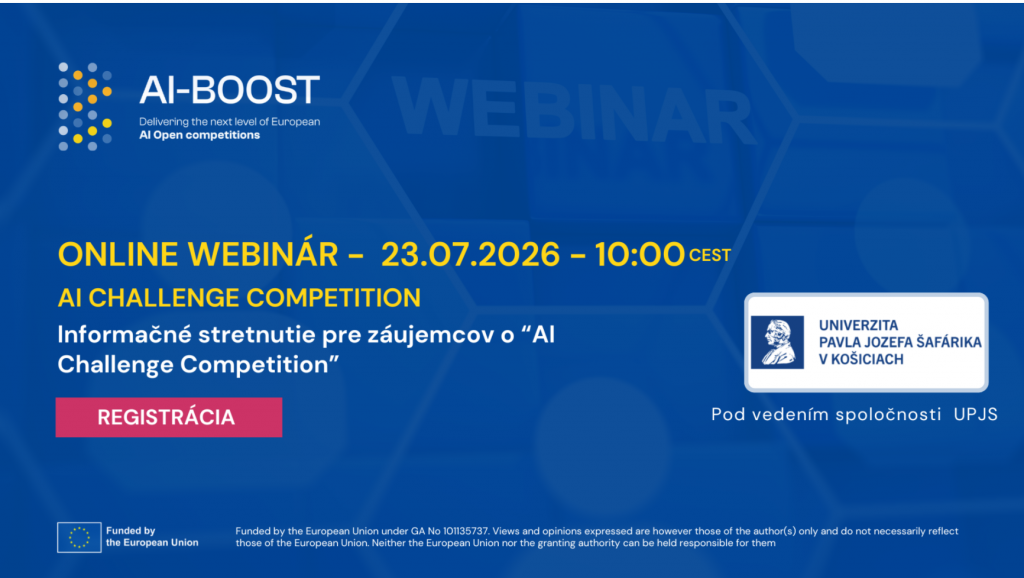



The AI-BOOST project, in which Pavol Jozef Šafárik University in Košice (UPJŠ) is a consortium partner alongside ZABALA, F6S, CINECA, INESC TEC, 28 DIGITAL, Universitat Pompeu Fabra, and UPJŠ, is a major European Union initiative aimed at fostering research, innovation, and talent in the field of artificial intelligence (AI). Funded under the Horizon Europe programme, the project seeks to address the fragmentation of the European AI ecosystem by strengthening collaboration among academia, industry, and public institutions. Its overarching objective is to support the development of trustworthy, ethical, and human-centric AI solutions that are competitive on a global scale.
One of the project’s core activities is the organisation of open innovation challenges designed to stimulate the development of novel solutions addressing current societal and industrial challenges. These challenges aim to encourage collaboration among research organisations, universities, start-ups, and businesses while accelerating the transfer of research results into practical applications.
One of the project’s core activities is the organisation of open innovation challenges designed to stimulate the development of novel solutions addressing current societal and industrial challenges. These challenges aim to encourage collaboration among research organisations, universities, start-ups, and businesses while accelerating the transfer of research results into practical applications.
The AI Challenge Competition is currently open as part of the AI-BOOST project, featuring four thematically distinct challenge tracks. This Europe-wide competition is open to researchers, universities, start-ups, small and medium-sized enterprises (SMEs), and other innovative teams. It therefore offers an excellent opportunity for participants from Slovakia to showcase their expertise, collaborate with leading European partners, and compete for substantial financial support.
The competition will follow a 2 phase-funnel approach:
- Spark Phase: Submit a Concept Note for evaluation, with five selected winners per challenge each receiving a €28,500 prize and a place in the next stage.
- Advance Phase: Complete a five-month development and validation programme, culminating in a live demonstration to compete for a final €100,000 prize.
The competition focuses on four current challenge areas of significant societal and industrial relevance:
- 1.Challenge: GenAI-Based Natural Language Mission Generator for Autonomous Robots in Agriculture – Led by Consorzio Intellimech and JOiiNT LAB, this challenge aims to democratise robotic programming by using Generative AI to translate natural language into machine-executable commands. Leveraging advanced Vision-Language-Action (VLA) models, participants will develop a modular proof of concept that bridges the gap between human intent and robotic execution, initially focusing on agricultural applications while enabling broader industrial use.
- 2.Challenge: Agentic AI for Automated CAD Generation and Autonomous Simulation – Led by the SIAD Group, this challenge focuses on developing an agentic AI system to streamline the design and simulation of industrial piping, specifically the routing of compressor tubes within skids. The solution will translate natural language requirements and existing CAD data into editable parametric models, automating engineering tasks such as constraint extraction, mesh generation, and convergence analysis.
- 3. Challenge: Generative AI for Enhancement of Clinical Datasets – Led by the European Federation for Cancer Images (EUCAIM), this challenge focuses on the use of Generative AI to improve the quality and representativeness of clinical imaging datasets, which are often incomplete or imbalanced. By generating realistic synthetic patient cohorts, participants will help address critical data gaps and support the development of more robust AI models for healthcare.
- 4.Challenge: Generative AI for Automatic Test Case Generation from Crash Databases & Standards – Led by Siemens Industry Software NV in collaboration with EU RobustifAI, this challenge aims to improve the safety validation of autonomous driving systems by using Generative AI to automate the creation of simulation scenarios based on crash databases and international safety standards.
For selected challenges, participants will have access to the computational resources of Leonardo, one of Europe’s most powerful supercomputers, operated by the project partner CINECA. Pavol Jozef Šafárik University in Košice (UPJŠ) is responsible for the organisational coordination of the third challenge.
Application deadlines:
Challenges 1 and 2: 25 August 2026
Challenges 3 and 4: 8 September 2026