


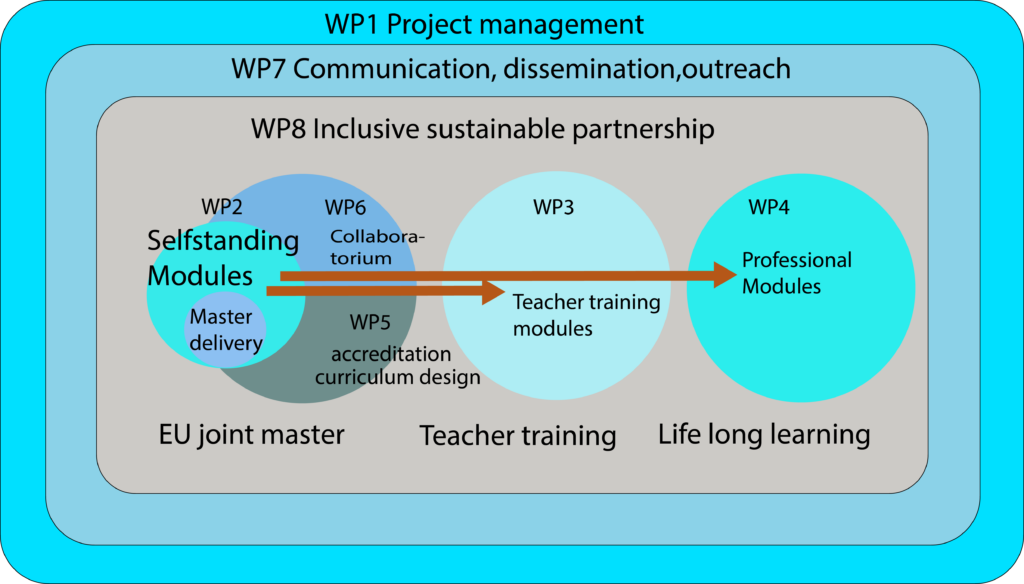
Within the EURIDICE project, project activities are organised into eight work packages. These are coordinated and implemented by different groups of consortium partners.
WP1: Project Management and Coordination
WP1 ensures the effective management and coordination of the EURIDICE project. Its main activities include organising meetings, coordinating activities among partners, monitoring progress, financial management, and preparing periodic reports for the European Commission. The outputs include administrative and financial reports, as well as the effective management of the Grant Agreement and internally agreed policies on intellectual property, diversity, and inclusion.
WP2: EU Master Modules: Content Design, Delivery and Certification
This work package focuses on the development and delivery of learning modules for Master’s students. All participating universities will collaborate on the development of digital learning resources that will be made available as part of the Digital Society, Social Innovation and Global Citizenship study programme. The outputs include comprehensive learning materials and accredited modules ready for implementation.
WP3: Teacher Education Modules: Content Design, Delivery and Certification
The content and outputs developed under WP2 will be adapted to meet the needs of trainers and educators. WP3 focuses on preparing learning materials for teachers and providing training aimed at integrating digital competences into the educational process. The main objective is to develop short-term training programmes that enable educators to teach digital skills effectively and prepare students for the challenges of the digital society.
WP4: Professional Training: Content Design, Delivery and Certification
This work package focuses on the development and implementation of training for professionals outside the ICT sector. The modules are tailored to the needs of businesses, industry, and public administration to support digital transformation across different sectors. The outputs include short-term educational programmes for professionals, their certification, and assessment within the European microcredential framework.
WP5: EU Joint Master: Curriculum Design and Accreditation
The aim of WP5 is to develop and formally accredit a joint European Master’s programme. The project partners will prepare a comprehensive curriculum that will undergo formal accreditation within the EU. The main outputs include a completed curriculum proposal and the submission of an accreditation application, with the aim of having the programme officially recognised and offered by multiple universities.
WP6: Collaboratorium: Digital Infrastructure and Student Support for Blended International Hybrid Education
WP6 focuses on developing and implementing the digital infrastructure required for international hybrid education. Its aim is to create digital environments that facilitate effective collaboration between universities and to provide scholarships and support for students. The outputs include an interoperable digital platform and the introduction of a fair selection process for scholarships for disadvantaged students.
WP7: Communication and outreach
WP7 encompasses the project’s communication and promotional activities aimed at raising awareness of EURIDICE and its outputs among academia, industry, and the wider public. Planned activities include organising conferences, cooperating with UNESCO and public institutions, using the media to communicate project results, and disseminating digital educational resources.
WP8: Inclusive Sustainable Partnership: European Digital Social-Educational Innovation Ecosystem
This work package focuses on establishing long-term cooperation between universities, industry, and civil society organisations. Its aim is to build an innovation ecosystem that supports digital education and social innovation. The main activities include organising workshops and lectures and developing a framework for cross-sectoral cooperation.