



Ten years ago, Ising superconductivity was discovered in a single layer of NbSe₂, which has unique quantum properties and could be used, for example, in the development of topological quantum computers. A typical feature of this phenomenon is that superconductivity can withstand extremely strong magnetic fields if they are oriented parallel to the layer. However, two-dimensional materials are impractical, and adding additional layers of NbSe₂ usually causes this phenomenon to disappear. A research team from Košice from the Institute of Physics at the Faculty of Science at Pavol Jozef Šafárik University and the Institute of Experimental Physics of the Slovak Academy of Sciences, in cooperation with scientists from two French universities led by Mgr. Tomáš Samuely, PhD. has shown that with specific symmetry breaking, Ising superconductivity is preserved with any number of layers in a 3D NbSe₂ crystal. This discovery was published in Physical Review Letters, one of the most prestigious scientific journals focused on physics research. The journal is included in the Nature Index (https://www.nature.com/nature-index/faq#journals ) and has an impact factor of 9.
- Volavka, D., Kačmarčík, J., Moško, T., Pribulová, Z., Stropkai, B., Bednarčík, J., Gao, Y., Moulding, O., Méasson, M.-A., Marcenat, C., Klein, T., Sasaki, S., Cario, L., Gmitra, M., Samuely, P., & Samuely, T. (2026). Ising Superconductivity in Noncentrosymmetric Bulk NbSe2. Physical Review Letters, 136(1), 016002. https://doi.org/10.1103/qxb4-sf28
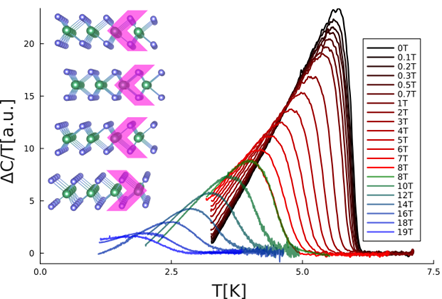
Fig.: Measurements of thermal capacity showed that even a magnetic field of 8 T, which is the maximum available in Košice laboratories, was unable to suppress superconductivity in NbSe₂ (black and red curves). Further measurements were carried out in France (green and blue curves). Inset: The orientation of NbSe2 layers features broken inversion symmetry.