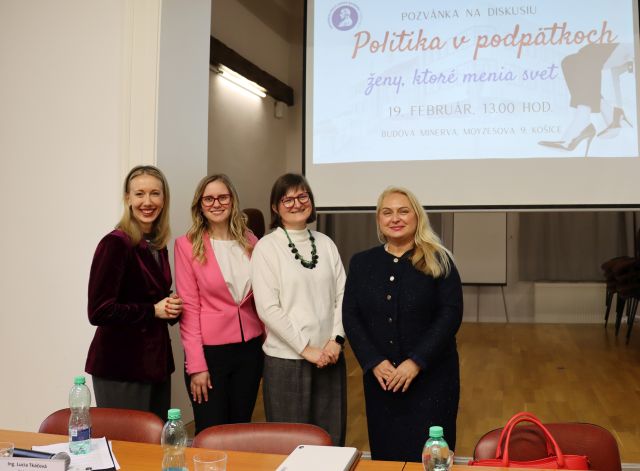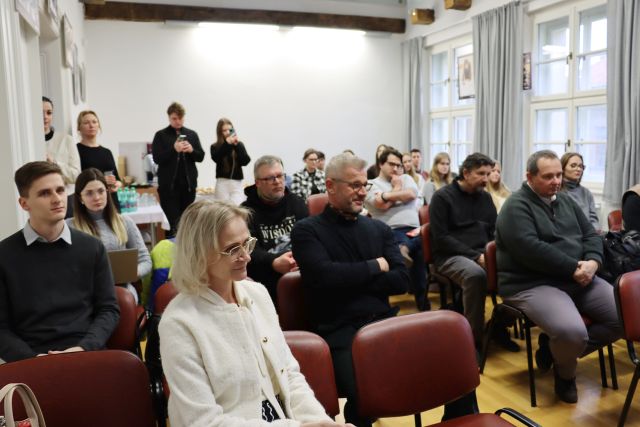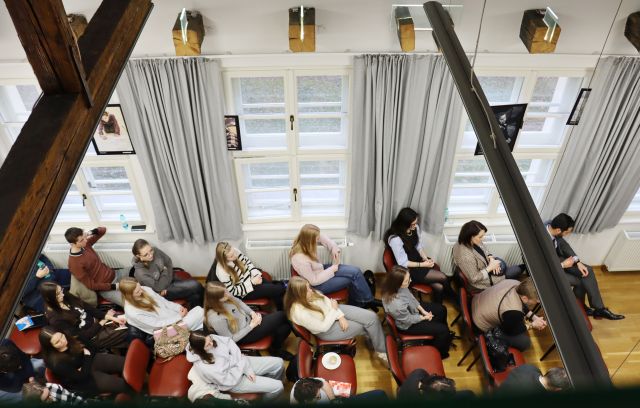



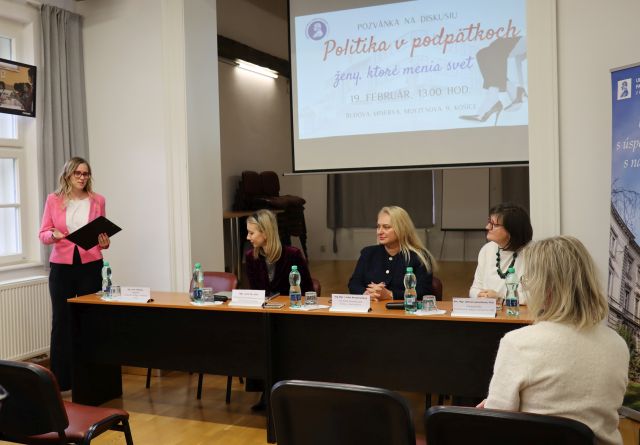
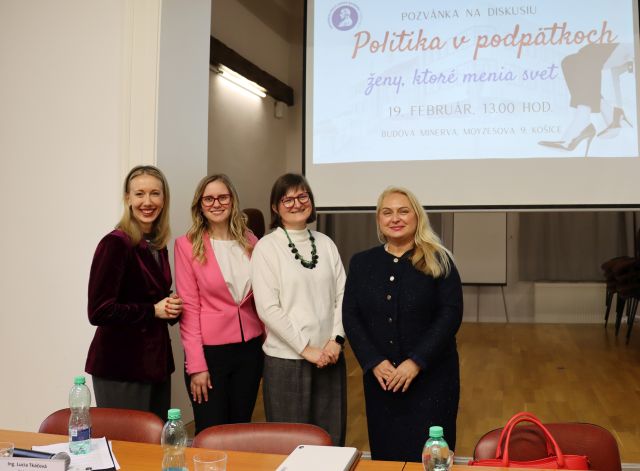
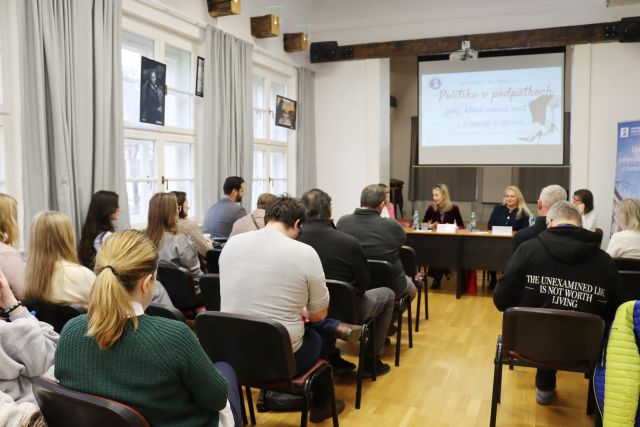
On February 19, 2026, at 1 PM a discussion focused on the topic of women’s careers in politics took place in the lecture hall of the Minerva building.
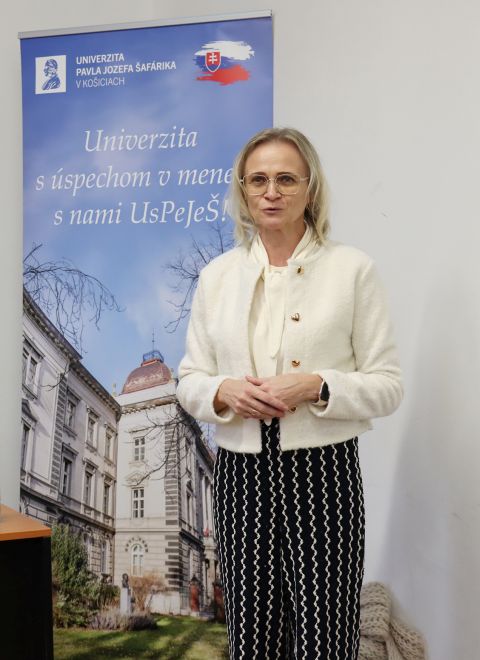
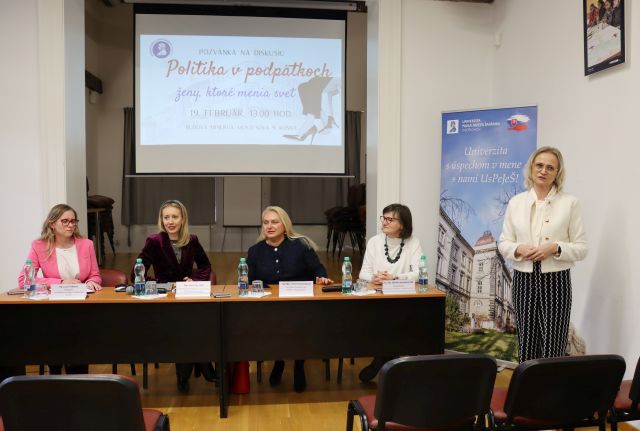
The audience was welcomed by doc. PaedDr. Renáta Orosová, PhD., Vice-Rector for Interdisciplinary Education and Innovation: “Today we will not talk about politics as a system of power and decision-making, but about politics as a space for courage, values, competence, and personal stories. High heels are a symbol of a step forward, a step into the public sphere, taking responsibility, formulating visions, and changing reality. Public life today needs expertise, integrity, empathy, and the ability to engage in dialogue. It needs diversity of perspectives and experiences. And it is precisely the involvement of women in decision-making processes that brings a broader perspective, sensitivity to social issues, but also an emphasis on cooperation and sustainable solutions.“
Moderator and discussion initiator Ing. Lucia Tkáčová, a doctoral student in the clinical biochemistry program at the Faculty of Medicine of UPJŠ in Košice, introduced the guests and the content of the discussion at the beginning.
Guests:
Mgr. Lucia Yar, MEP, Member of the European Parliament (PS/Renew Europe),
Ing. Mgr. Lenka Kovačevičová, Mayor of Košice – Nad Jazerom (independent),
doc. Mgr. Adriana Jesenková, PhD., Chair of the Commission for Gender Equality at UPJŠ in Košice, Department of Philosophy, Faculty of Arts, UPJŠ in Košice.
The path to the public sphere: Motivation and obstacles
The main goal of the discussion was to share the real experiences, challenges, and obstacles that the invited women faced when entering public life. The participants agreed that their primary motivation was not a desire for power, but an effort to be not just passive observers of public events, but also active creators of them. In this context, Associate Professor Adriana Jesenková recalled the etymological origin of the word politics, which is derived from the ancient Greek polis. This term referred to everything related to life in the community, the city-state, and the administration of public affairs. To be a political person means to be part of a certain community and to strive to improve it. She emphasized that engagement in public affairs is key to a functioning democracy and that the connection between academia and public life is extremely desirable.
However, women entering politics currently face specific barriers. The participants pointed to growing incivility and aggression in this work environment, as well as cyberbullying and various forms of online attacks, which are often directed not only at female politicians themselves, but also at their families and children. Mayor Lenka Kovačevičová added that women in local politics are still in the minority—there are currently only eight women in the Košice City Council, and only four of the 22 city districts are represented by female mayors.
Gender stereotypes and role reconciliation
A prominent topic of discussion was the persistence of gender stereotypes, which weaken the representation of women in decision-making processes. All the women present confirmed that politics is often perceived as an exceptional profession with demanding schedules. Late-night meetings, time flexibility, and frequent business trips are a significant complication for women, who still bear the main burden of caring for the household and family in our society. Caring for others is also a frequent obstacle to employment in other professions.
In this context, MEP Lucia Yar pointed out the huge differences in political culture between Slovakia and Europe. She raised the issue of quotas as a corrective, time-limited measure to redress generational decisions and help achieve a more equitable gender representation. She also mentioned the Women on Board initiative, which aims to ensure that at least 40% of board members of large private companies in the EU are women.
The path to change: Education and personal growth
The guests encouraged students to be active during their studies, for example in civic associations. Mayor Kovačevičová confirmed from her own experience that such activities build communication skills, contacts, and the necessary self-confidence. Associate Professor Jesenková sees the solution in greater integration of civic and ethical education, strengthening young people’s emotional attachment to values, European citizenship, and a gender-sensitive approach, which should be part of education from an early age. The conclusion of the discussion was marked by the conviction that women, as part of diversity, bring more empathy, diplomacy, and a stronger emphasis on cooperation and sustainable solutions to politics. With their diverse experiences, women enrich politics with a diversity of perspectives and increase the likelihood of inclusive democratic political practice. As MEP Yar pointed out, the involvement of women is not only a matter of justice, but also a necessary step towards a broader view of the needs of society as a whole. According to the participants in the discussion, these facts underscore the importance of women being involved in lawmaking and not leaving decisions about their lives solely to men.
After the discussion, Ján Haraslín, M.A., Community Manager of the European Parliament Office in Slovakia, took the floor and presented internship opportunities in EU institutions to the students present.